
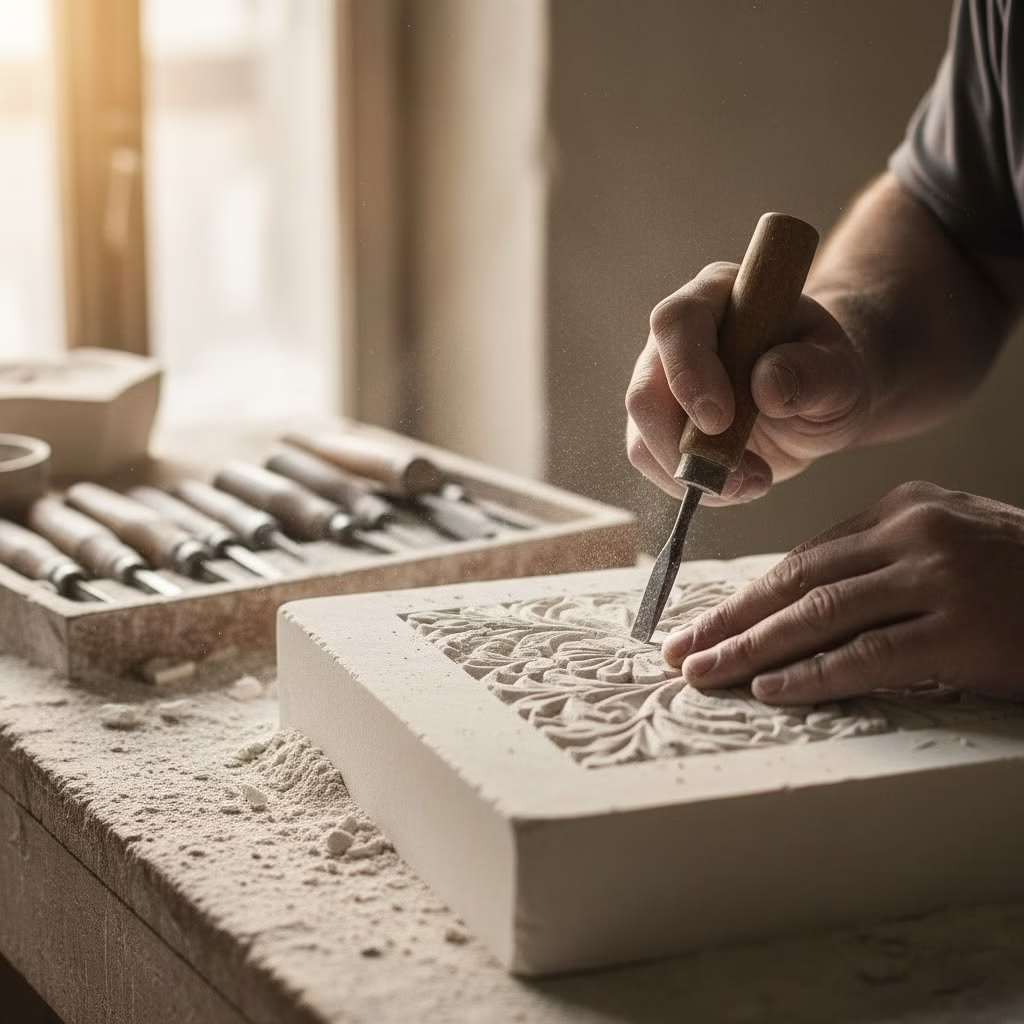
Hello folks! Have you ever looked at a temple wall and wondered how those gods and goddesses seem to come alive in stone? Or thought about the hands that spent months chiseling every single detail? Welcome to the world of Indian stone art – a tradition that has been breathing life into rock for over two thousand years.
Indian stone art is not just about carving. It is about devotion, precision, and an ancient science called Shilpa Shastra. They transformed hard granite, marble, and sandstone into soft, flowing figures. The temples of Khajuraho, Konark, and Mahabalipuram are living proof of this mastery.
Today, we are exploring the tools, techniques, and timeless traditions of Indian art stone. Let’s dive in! 🗿✨
The Ancient Science Behind Stone Art
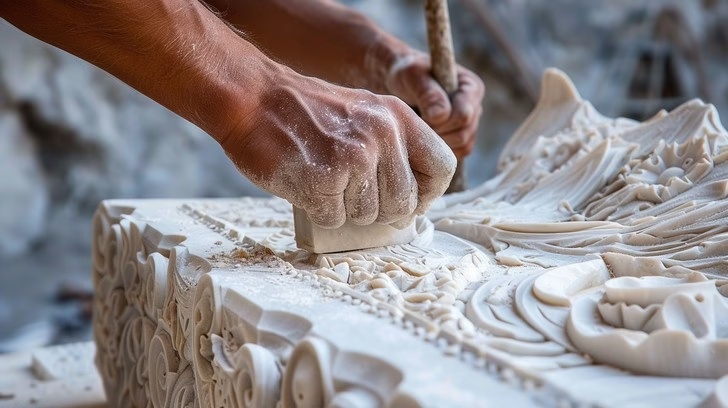
Before a sculptor touches the chisel to stone, he follows a sacred blueprint. This is the Vastusutra Upanishad – an ancient text that guides everything from the selection of stone to the final polish. Stone art in India is governed by a profound understanding of geometry, anatomy, and aesthetics.
The Eight Parts of the Purusha: The Sacred Geometry
According to the Vastusutra Upanishad, the sculptor must divide the figure into eight essential parts. This is not just a sketch. It is the divine architecture of the image. The text divides the human body into nine essential parts, which include compositions, ornamentations, gestures, postures, weapons, vehicles, subordinate divinities, enemies, and devotees.
The Eight Parts of the Purusha:
| Part | Meaning |
| Parthibanga | The Earth Part – foundation and grounding |
| Karmanga | The Working Part – hands and actions |
| Adho-anga | The Lower Part – legs and stability |
| Prajanan-anga | The Procreative Part – creative energy |
| Pramanga | The Breath Part – life force and vitality |
| Uttamanga | The Neck and Face – expression and identity |
| Jyotiranga | The Enlightened Part – spiritual radiance |
| Tunganga | The Top – crown and connection to the divine |
Purpose: This ensures that the limbs are perfect in their proportions. The sculptor must have knowledge of geometry, anatomy, and aesthetics. The system of dividing the figure ensures that every part is in harmony with the whole. This is the foundational principle of Indian stone art.
The Rasa Principle: Emotion in Stone
The Vastusutra Upanishad also emphasizes the use of rasa (mood). The sculptor must be aware of the expression he wants to convey.
Whether the deity is peaceful, fierce, or benevolent, the treatment of the face, posture, and ornaments must reflect the correct emotion. This emotional depth is what sets Indian stone art apart.
The Nine Rasas in Indian Sculpture:
| Rasa | Emotion | Visual Indicators |
| Shringara | Love | Graceful posture, soft features, ornaments |
| Hasya | Laughter | Playful expressions, open mouths |
| Karuna | Compassion | Gentle eyes, protective gestures |
| Raudra | Anger | Fierce eyes, weapons, aggressive stance |
| Vira | Heroism | Bold posture, strength, confidence |
| Bhayanaka | Fear | Wide eyes, defensive posture |
| Vibhatsa | Disgust | Avoidance, turning away |
| Adbhuta | Wonder | Wide eyes, upward gaze |
| Shanta | Peace | Serene face, meditative posture |
The Rasa Experience: Rasa is a dynamic experience between the artist, expression, and those who receive it.
The sculptor’s skill lies in evoking the intended emotional response from the viewer through form, posture, and expression. This makes Indian stone art a deeply immersive experience.
The Four Processes of Engraving: The Art of Cutting Stone
According to the Silpasastra texts, the art of cutting stone (sailabhedanam) involves four primary techniques. These processes describe different approaches to carving and are fundamental to understanding Indian art stone techniques.
The Four Processes Explained
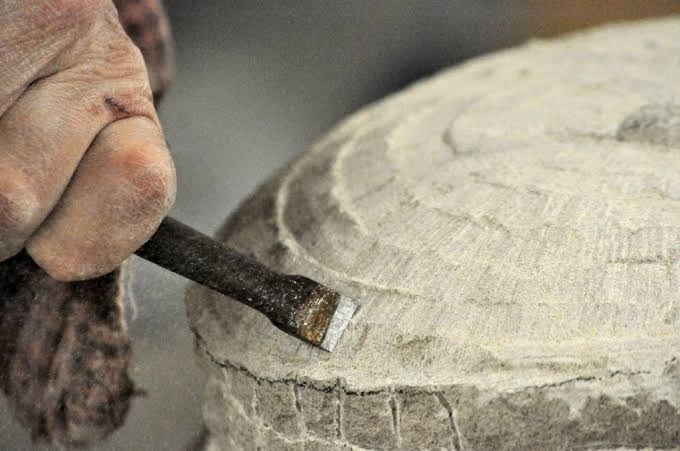
1. Ekasrayi – Carving from a Single Side
This is the most straightforward approach. The sculptor works on the stone from a single direction, creating a bas-relief or a figure that is visible primarily from one viewpoint.
Key Features:
- Ideal for wall panels and narrative friezes
- Suitable for softer stones like sandstone
- Common in temple wall carvings
- Creates a shallow depth of field
2. Yugalasrayi – Carving from Two Sides
This process involves working on the stone from two opposite sides. It allows for a more three-dimensional effect.
Key Features:
- Creates figures that are viewable from both sides
- Suitable for freestanding pillars
- Requires more planning and precision
- Seen in some Hoysala temple sculptures
3. Khandasrayi – Carving in Sections
This is the most complex technique. The sculptor divides the figure or composition into sections and carves each part separately before assembling them.
Key Features:
- Used for larger, more complex compositions
- Allows for detailed work on each section
- Requires precise planning and fitting
- Seen in large multi-figure compositions
4. Sparsita – Carving in Relief
This refers to techniques where the figure is carved in relief, emerging from the background surface.
Key Features:
- Can be high relief or low relief
- The figure appears to emerge from the stone
- Common in narrative panels and decorative borders
- The Rampurva Bull is an example of masterful relief carving
The Actual Carving Process:
Holding the chisel in the left hand, the sculptor employs the mallet with the right hand. The narrow incisions are chiseled between the limbs of the body. The sculptor cuts stone, curves various forms, and creates limbs on the basis of his efficiency.
Step-by-Step Process:
- The stone block is selected and fixed
- A central hole is created on the stone
- Lines are drawn on the surface to establish the grid system
- The limbs of the image are set along these lines
- The sculptor cuts stone, curves various forms, and creates limbs based on his efficiency
- Gradually, the implements, ornaments, turbans, ear ornaments, and crowns are depicted
The Pallava Technique:
The Pallava rock-cut sculpture tradition (7th-9th centuries) used hard materials such as granite, gneiss, and charnockite.
The earlier Mauryas and Guptas used softer sandstone, but the Pallavas deliberately used hard stone, creating entire monolithic temples and large sculptures “in the round”. This demonstrates the evolution of stone art in India.
Materials: The Stone Carver’s Palette
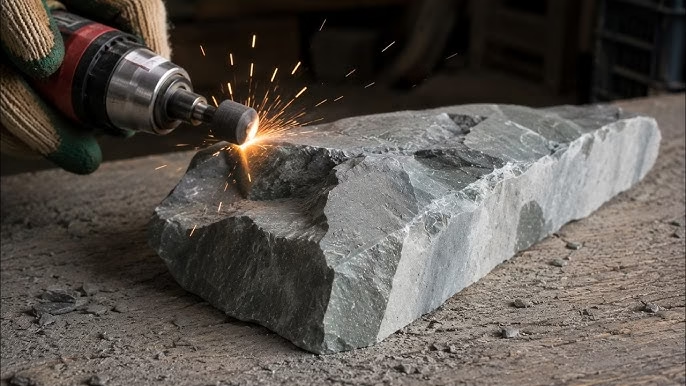
India’s geological diversity has given rise to a wide variety of stone art. Different stones offer different possibilities to the sculptor.
Types of Stone Used
| Stone Type | Characteristics | Famous Sites/Regions |
| Granite | Extremely hard, durable | Pallava temples (Mahabalipuram), Karnataka |
| Sandstone | Soft, easy to carve, rich red color | Khajuraho, Mughal forts (Red Fort), Rampurva Bull |
| Marble | Smooth, white, translucent | Taj Mahal, Dilwara Temples (Mt Abu) |
| Black Granite | Dark, hard, takes high polish | Patharkatti art (Bihar), Vishnupad Temple |
| Soapstone/Steatite | Soft, easy to carve, takes intricate details | Chalukya and Hoysala temples (Belur, Halebidu) |
| Quartzite/Gneiss | Hard, grainy | Early Pallava caves |
The Rampurva Bull: A Masterpiece of Sandstone
The Rampurva Bull is a magnificent third-century B.C. sandstone capital of an Ashokan Pillar discovered in Rampurva, Bihar. It is noted for its delicately sculpted model demonstrating superior representation of soft flesh, sensitive nostrils, alert ears, and strong legs.
The sculpture is a masterpiece of Indian craftsmanship and is said to have a “velvet touch.” Weighing up to five tonnes, this invaluable artifact is now housed at the Rashtrapati Bhavan in New Delhi. This is a prime example of stone art from ancient India.
The Importance of Makrana Marble
The quarries at Makrana in Rajasthan are world-famous. It was from these quarries that the marble for the Taj Mahal was mined.
The exquisite Dilwara Jain temples at Mount Abu are also built from Makrana marble, showcasing the incredible possibilities of art stone.
Jali Work: The Art of Perforated Screens
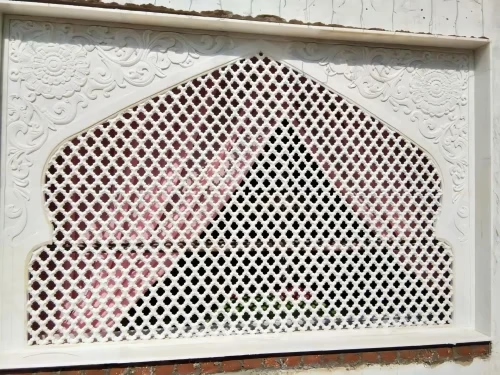
Rajasthan’s stone carvers are particularly noted for their jali (latticework) carvings. These intricate screens were used frequently in the windows of the zenanas (women’s quarters), enabling women in purdah to view court events without being seen. This is a unique form of stone art that combines functionality with beauty.
Features of Jali Work:
- Offers protection from the sun and heat
- Allows passage of fresh air through intricate geometric patterns
- Made from both sandstone and marble
- Intricate details transport you to the ancient era of Hindu dynasties
Places to see fine examples: Jaipur, Udaipur, Jodhpur, Bikaner, Ajmer.
Beyond the Chisel: Stone Painting
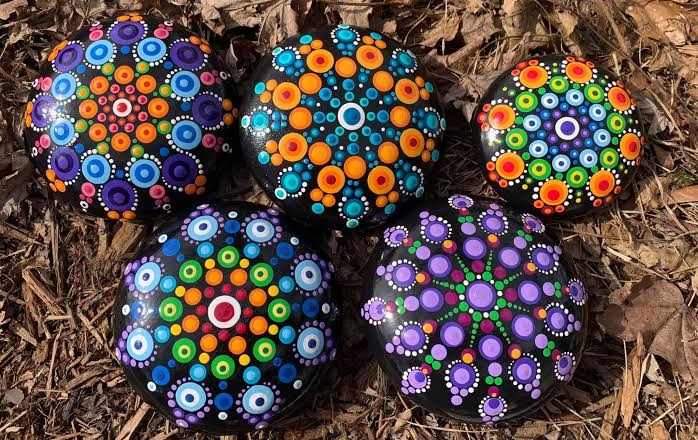
While traditional Indian stone art is about carving, there is a unique contemporary practice known as stone painting.
The Jadd Chetan Technique
Artist Siddhesh (1924-1996) developed a unique ability. He would spot an object in an inanimate, naturally carved stone lying around. The stone would “speak” to him.
Without using a chisel, he identified the contours and shapes, then filled them in through his palette and revealed the figure to the world. This became popular as Jadd Chetan.
Stone Dust Painting
In Rajasthan and Haryana, a craft called “Stone Dust Painting” has emerged. Artisans use stone dust mixed with artistic techniques to create 3D paintings and 5D paintings on canvas.
The sparkle work in these paintings is particularly popular. A stone painting can cost anywhere from ₹300 to ₹1,800.
GI Tags and Market Evolution
The relevance of Indian stone art is being recognized in modern times through Geographical Indication (GI) tags.
Patharkatti Stone Art
In 2025, the 300-year-old stone art of Bihar’s Patharkatti village received its long-awaited GI Tag. The hallmark of this GI-tagged product is the use of black granite, a distinctive material found in abundance in the region.
Key Figures:
- Associated with over 650 artisans from Patharkatti village
- Sculpt idols and artwork of Lord Buddha, Lord Mahavira, and other figures
- The Vishnupad temple in Gaya is said to have been built using this very black granite
The Economic Impact
The recognition paves the way for:
- Promotion and commercialization in national and international markets
- Reviving the legacy of centuries-old craftsmanship
- Ensuring authenticity and protection from imitation
- Increasing the income of local artisans
Cost: The GI registration application fee has been reduced by 80%, from ₹5,000 to ₹1,000, and the renewal fee from ₹3,000 to ₹500, making it easier for artisan communities to protect their crafts.
The Legacy of Indian Stone Art
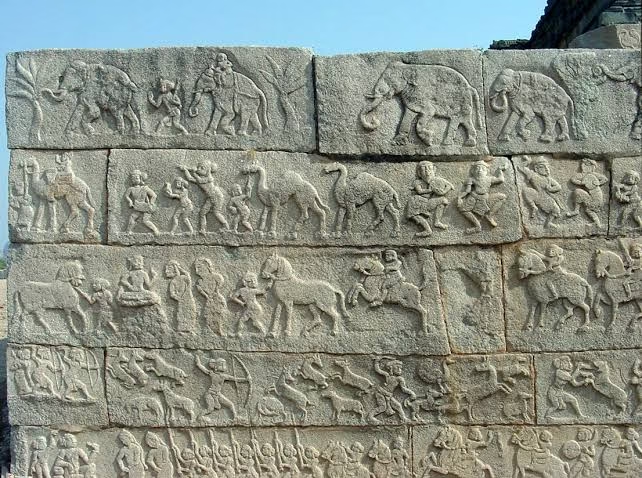
Indian stone art is a continuous tradition that spans from the elaborate carvings of the Khajuraho temples to the intricate sculpture at Vijayanagara.
The Vijayanagara Tradition (14th-16th Century)
The artists of the Vijayanagara period excelled in handling large granite blocks. The carvings on the Mahanavami platform showcase a variety of friezes. The sculptors arranged the carved and uncarved spaces to impart a unique rhythmic quality to the ensemble.
Stylistic Traits:
- Compartmentalization: A tendency to divide the friezes into self-enclosed units, perfecting the rhythmic quality
- Minute Carving: A tendency towards minute, jewel-like work in schist
- Narrative Flow: In the Ramachandra temple, the narrative frequently overlaps panels, flowing from one block to the next without interruption
The Mauryan Legacy
The Mauryan period (3rd century B.C.) produced some of the finest examples of Indian stone art. The Ashokan pillars, including the Rampurva Bull, are celebrated for their polished sandstone surfaces and masterful representation of animal forms.
The Rampurva Bull is a mixture of Indian and Persian elements. Whereas the motifs on the base, atop the inverted lotus, the rosette, palmette, and the acanthus ornaments are not Indian features, the bull capital is a masterpiece of Indian craftsmanship.
Modern Artisans and Their Legacy
Today, artisans like Sanjay Garg from Agra continue the tradition of art stone carving. Inspired by Mughal miniature art, he works with soapstone to create intricate sculptures.
He brings together 15 artisans in his workshop and was awarded the State Award for Miniature Painting in 2013.
He expresses his mission: “I wish to spread the beauty of this art to the whole world, because miniature painting is an ancient art and I want to preserve this art form”.
Quick Facts
- Guilds of masons have existed since the 7th century B.C.
- The Vastusutra Upanishad provides guidelines for sculptors
- The Rasa theory was codified in the Natya Shastra (200 BC-300 AD)
- Pallava rock-cut tradition used hard granite (7th-9th century)
- Makrana marble was used for the Taj Mahal
- Patharkatti Stone Art received a GI Tag in 2025
- Over 650 artisans work in Patharkatti village
- The Rampurva Bull weighs up to five tonnes
- Soapstone is preferred for intricate Jali work
FAQs
Q1. What is Indian stone art?
Indian stone art refers to the ancient tradition of carving sculptures, temples, and reliefs from stone. It follows sacred guidelines from texts like the Vastusutra Upanishad and includes techniques like relief carving, in-the-round sculpture, and intricate jali work.
Q2. What are the four processes of engraving in Indian sculpture?
They are Ekasrayi (carving from one side), Yugalasrayi (carving from two sides), Khandasrayi (carving in sections), and Sparsita (carving in relief).
Q3. What is the Rasa theory in Indian art?
It is an aesthetic principle where the sculptor evokes specific emotions in the viewer through form, posture, and expression. The nine rasas include love, laughter, compassion, anger, heroism, fear, disgust, wonder, and peace.
Q4. What is stone painting?
Stone painting is a modern practice where artists either paint on natural stone surfaces or use stone dust mixed with artistic techniques to create 3D and 5D paintings on canvas. The Jadd Chetan technique and stone dust paintings are popular examples.
Q5. What is the Rampurva Bull?
It is a third-century B.C. sandstone capital of an Ashokan Pillar discovered in Bihar. It is noted for its masterful representation of soft flesh, sensitive nostrils, and alert ears.
Q6. What is Patharkatti stone art?
It is a 300-year-old carving tradition from Bihar that uses black granite. It was granted a GI tag in 2025 and is associated with over 650 artisans.
Q7. What is Jali work?
Jali is the intricate perforated latticework carved in stone, primarily used in Rajasthan for windows and screens to allow airflow while maintaining privacy.
Q8. Is Indian stone sculpture still practiced today?
Yes, modern artisans like Sanjay Garg continue the tradition of art stone carving, working with soapstone and other materials and passing on their skills to new artisans.
Also Read:
Kaavad Art and Acrylic Canvas Rajasthani Paintings – Art Rajasthan Explained

Leave a Reply