

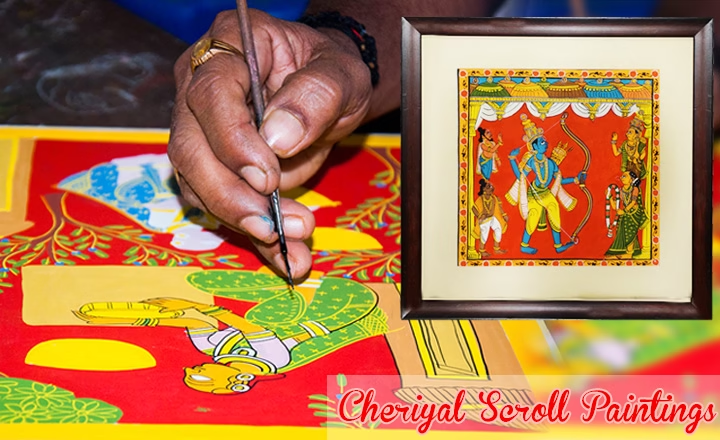
Hello, folks. Let me talk about something fragile. Cheriyal scroll painting is a Telangana Traditional Art. It comes from one small village. Once, every storyteller carried these scrolls. Some were 50 feet long. They were like ancient comic books.
But here’s the hard truth. Only one family—the Nakash family—still makes them. UNESCO gave it recognition. That didn’t fill empty hands. Today, fewer than 15 artists practice this art. Each scroll takes weeks. The colors are raw reds and blacks. The figures have big hands and popping eyes. They told folk tales. Epics. Satires.
I felt a knot in my chest when I learned this. Not for sympathy. Because art this honest deserves to live on. Not just in museums. But in our sight. In our words.
So this is my small tribute. To remember Cheriyal scroll painting. To keep Telangana’s traditional art breathing. Just a little longer.
What Is Cheriyal Scroll Painting? Understanding the Visual Storyteller
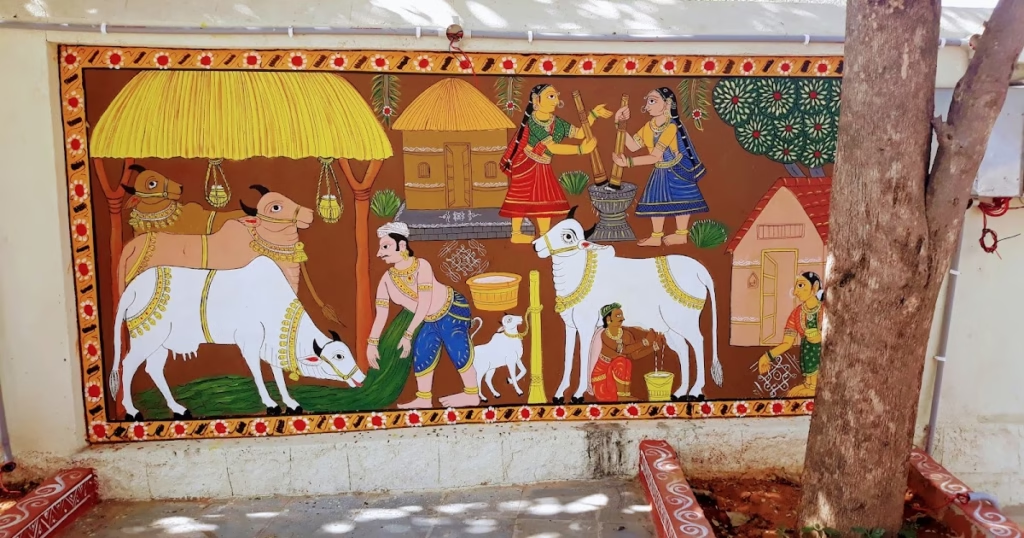
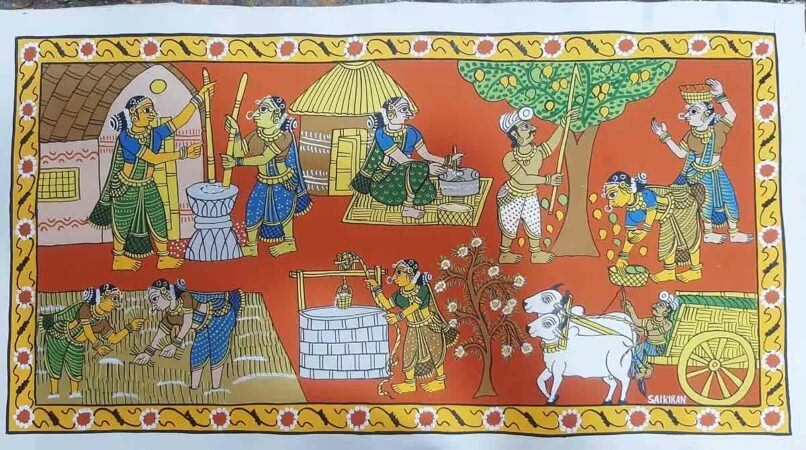
Cheriyal scroll painting is a distinct form of Telangana Traditional Art originating from Cheriyal village, about 90 kilometers from Hyderabad. Unlike framed paintings, these are long, horizontal scrolls—sometimes stretching 40 to 60 feet. Imagine a hand-painted graphic novel unrolled scene by scene. That is Cheriyal art.
Key features include:
- Bold color palette: Deep indigo, raw vermilion, earthy yellow, and black. No blue or green traditionally.
- Exaggerated figures: Large hands, protruding red tongues, and popping eyes to express emotion clearly from a distance.
- No perspective or shading: Flat, two-dimensional storytelling that mimics ancient cave painting traditions.
- Fabric base: Handwoven khadi cloth coated with a paste of tamarind seed powder, white clay, and gum.
Each scroll tells a complete story—a folk epic, a myth, or a social satire. The painter works like a film director, deciding which scene follows which. The scroll is then rolled from one side to the other as a bard (called a golla or kaki) sings the tale. One scroll could entertain a village for an entire night.
Today, Cheriyal scroll painting survives almost solely through the Nakash family, who have practiced it for over 12 generations. The government of India has given it a Geographical Indication (GI) tag. But make no mistake—this is not a tourist trinket. It is a living, breathing archive of Telangana’s soul.
History of Cheriyal Scroll Painting (Timeline Wise)
The history of Cheriyal scroll painting as a Telangana traditional art spans centuries. Below is a concise timeline.
- 14th–16th Centuries (Birth of the Form)
The art emerged during the Kakatiya dynasty. Wandering bards needed visual aids for storytelling. Scroll painters (nakash) and singers (golla) formed hereditary partnerships. - 17th–18th Centuries (Golden Age under Qutb Shahis & Asaf Jahis)
Patronage grew. Scrolls became longer and more detailed. Themes expanded from myths to daily life, satire, and even erotic folktales. Every village had at least one family of scroll painters. - 19th Century (British Era Disruption)
Colonial education and printed books arrived. Oral storytelling declined. Patronage vanished. Many Nakash families abandoned the art for farming or daily labor. - 1950s–1980s (Near Extinction)
By the mid-20th century, only the Nakash family in Cheriyal village remained. Fewer than five artists knew the complete traditional method. - 2000s (Revival Attempts)
D. Vaikuntham and later D. Chakradhar (from the Nakash family) began training outsiders. The Andhra Pradesh government stepped in with workshops. - 2007 (GI Tag Granted)
Geographical Indication registration number 68. Legal protection granted. Suddenly, Cheriyal scroll painting had a second life. - Present Day (Fragile Survival)
Approximately 15–20 active artists today. Scrolls sell as souvenirs and museum pieces. But the oral singing tradition is almost extinct. The art survives—but barely.
Types of Cheriyal Scroll Paintings – A Detailed Classification
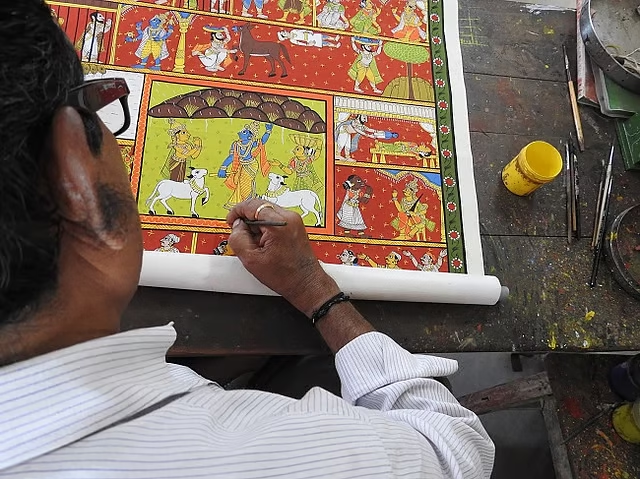
When most people think of Cheriyal scroll painting, they imagine gods and goddesses. But Telangana Traditional Art once contained at least six distinct scroll types. Below is a museum-grade breakdown.
1. Mythological & Epic Scrolls (Pauranika Cheriyalu)
Length: 20–60 feet
Primary Audience: Temples, village festivals, Brahmin households
Current Status: Most common surviving type
These scrolls tell stories from Hindu epics and local Telangana legends. Unlike printed storybooks, they rearrange scenes for dramatic effect.
Sub-types:
- Palnati Yuddham scrolls – The Mahabharata of Telangana. A 12th-century war epic involving 40+ characters. Scrolls run up to 60 feet with battle scenes every 2 feet.
- Markandeya Purana scrolls – Stories of the sage Markandeya. Known for the “lion killing the demon” panel, painted with exaggerated red tongues and bulging eyes.
- Ramayana (local version) – Not Valmiki’s version. Includes Telangana folk additions: Rama resting under a maddi tree, Sita grinding millet, and Hanuman speaking the Telangana dialect.
Visual markers: Multiple gods seated on peethams (low stools), floral borders in white dots, and a dark indigo sky behind every deity.
2. Social Satire & Morality Scrolls (Hasya – Vyanga Cheriyalu)
Length: 10–30 feet
Primary Audience: Village gatherings, harvest festivals, wedding evenings
Current Status: Nearly extinct (less than 5 scrolls remain in private collections)
These are the forgotten gems of Cheriyal scroll painting. No gods. No temples. Just landlords, cheats, drunkards, and greedy moneylenders painted with merciless honesty.
Common themes with examples:
- The Corrupt Patel (village headman)—Shown sitting on a high cot, taking bribes in one hand and beating a farmer with the other. His eyes are painted larger than any god’s.
- The Clever Kuruma (shepherd) – A recurring folk hero who outsmarts Brahmins, merchants, and even kings. One scroll shows him trading a goat for a kingdom.
- The Lazy Pujari – A priest sleeping while a snake enters the temple. The snake’s tongue touches the priest’s foot. The next panel shows him waking up and fainting.
Purpose: These scrolls were performed during Jatara (village fairs). The bard would sing in coarse Telangana dialect, and men would laugh until their stomachs hurt. Women were usually not present.
Why extinct: Colonial officers labeled them “vulgar.” Later, revivalists focused only on “respectable” mythological themes. Today, no young artist learns satire scrolls.
3. Erotic & Folk Romance Scrolls (Sringara Cheriyalu)
Length: 15–40 feet
Primary Audience: Adult male gatherings, night-long performances in winter
Current Status: Almost extinct (2 known scrolls in Hyderabad museum storage)
Yes, Telangana Traditional Art had an erotic branch. But unlike Khajuraho sculptures, these were narrative and humorous, not devotional.
Sub-types:
- Kandukuri katha scrolls – Stories of Kandukuri, a rustic hero who sleeps with three women in one night while hiding from their husbands. Each scene shows exaggerated physical comedy.
- Matsya Purana folk adaptations – Not the actual Purana. Local bards took the fish avatar story and added sexual innuendos between Matsya and a fisherwoman.
- Bathukamma romance scrolls – Linked to Telangana’s flower festival. Shows a young man and woman exchanging puliogara (tamarind rice) and garlands before disappearing into a sugarcane field.
Visual markers: Women shown with oversized breasts and hip bends (the tribhanga pose). Men have bright red lower garments. The couple are often surrounded by parrots and flowering ganneru bushes.
Performance style: The bard sang in whispers after midnight. Women and children were sent to sleep. These performances sometimes lasted 6 hours.
Current status: No artist openly admits making these today. The last known public performance was in the 1970s.
4. Genealogical & Caste Lineage Scrolls (Vamsha Cheriyalu)
Length: 30–60 feet (longest category)
Primary Audience: Chieftains, landed gentry, caste councils
Current Status: Extinct in practice (a few exist in museums)
Before written property records, Cheriyal scroll paintings served as legal documents. A family’s right to land, water, or a temple depended on these scrolls.
How they worked:
- A chieftain hired a nakash painter to create his lineage scroll.
- The scroll showed his ancestor sitting at the left end, larger than life.
- Each subsequent generation sits to the right, slightly smaller.
- Important marriages are shown as a hand-holding scene between two families.
- Land grants shown as a measuring rod and a pile of grain.
Caste scrolls were different. They showed the origin myth of an entire community. For example:
- Mudiraj (fisher caste) scroll – Shows the first man emerging from a lotus with a fishing net.
- Goud (toddy tapper) scroll – Shows a man climbing a palm tree while a woman holds the pot.
Why extinct: British courts demanded written deeds, not painted cloth. By 1900, no new genealogical scrolls were commissioned.
5. Ritual & Votive Scrolls (Mokkubadi Cheriyalu)
Length: 3–10 feet (shortest category)
Primary Audience: Individual villagers, women devotees
Current Status: Rare, but some artists make simplified versions
These small scrolls were personal. A villager made a vow (mokkubadi) to a local deity. If the wish came true, he commissioned a tiny scroll as thanks.
Common vows and scroll content:
| Vow | Scroll shows |
| Child born after years of infertility | A woman holding a baby under a peepal tree |
| Crop saved from pestilence | A field of millet with a sickle and a full moon |
| Recovery from snakebite | A cobra with its fangs removed, tied to a stick |
| Son passes school exam (rare, British era) | A boy holding a slate and a Tamil book |
Unique feature: These scrolls were never performed publicly. The owner kept them rolled in a bamboo tube and hung them above the door. When the wish was fulfilled, the scroll was burned or offered to the deity’s shrine.
Current status: Some artists near Cheriyal village make miniature votive scrolls for tourists. But the original ritual meaning is lost.
6. Contemporary & Commercial Scrolls (Navina Cheriyalu)
Length: 2–10 feet
Primary Audience: Urban buyers, museums, home decor market
Current Status: Most produced type today (80% of current output)
This is not a historical category. It emerged after 2000 when the GI tag created commercial demand. Traditional artists had to adapt or starve.
Sub-types:
- Dashavatara panels – Ten avatars of Vishnu, each in a separate 1-foot square. Sold as single scrolls or wall hangings.
- Floral and peacock scrolls – No story. Just the Cheriyal visual language (red background, white dots, black outlines) applied to decorative motifs.
- Wedding souvenir scrolls – Custom-made for rich urban couples. Shows the bride and groom in Cheriyal style, with their names written in Telugu script.
- Single-episode scrolls – A 3-foot scroll showing just one scene (e.g., Krishna lifting Govardhan Hill). Easier to sell than a 40-foot epic.
Criticism from purists: Traditionalists argue that non-narrative scrolls are not true Cheriyal scroll paintings. They are just “Cheriyal-style paintings on cloth.” But artists respond, “Bills don’t pay themselves.”
Price range today:
- Miniature (2 ft): ₹2,000 – ₹5,000
- Medium (6 ft, single scene): ₹8,000 – ₹15,000
- Traditional (20 ft, mythological): ₹40,000 – ₹120,000
Quick Comparison Table – All Six Types
| Type | Length | Story? | Current Status | Who Buys Today |
| Mythological | 20–60 ft | Yes | Surviving | Museums, collectors |
| Social Satire | 10–30 ft | Yes | Nearly extinct | Nobody |
| Erotic | 15–40 ft | Yes | Almost extinct | Private collectors (illegal?) |
| Genealogical | 30–60 ft | Yes | Extinct | Museums only |
| Ritual Votive | 3–10 ft | Sometimes | Rare | No one (ritual dead) |
| Contemporary | 2–10 ft | No (mostly) | Thriving | Urban home decor buyers |
Why Understanding Types Matters
If you only know mythological Cheriyal scroll painting, you know less than 20% of what this Telangana traditional art once was. The satirical, erotic, and genealogical scrolls tell a raw truth: this art was not always sacred. It was sometimes funny, sometimes naughty, and sometimes legal evidence.
Today, revivalists have cleaned up the history. They show only gods. But the real Cheriyal village knew better. Ask the oldest Nakash family member quietly. He might still remember a satirical scroll his grandfather painted—a landlord falling into a well while chasing a poor man’s goat.
That scroll is gone now. But the memory of it? That is the true Cheriyal scroll painting.
Materials Used in Cheriyal Scroll Painting
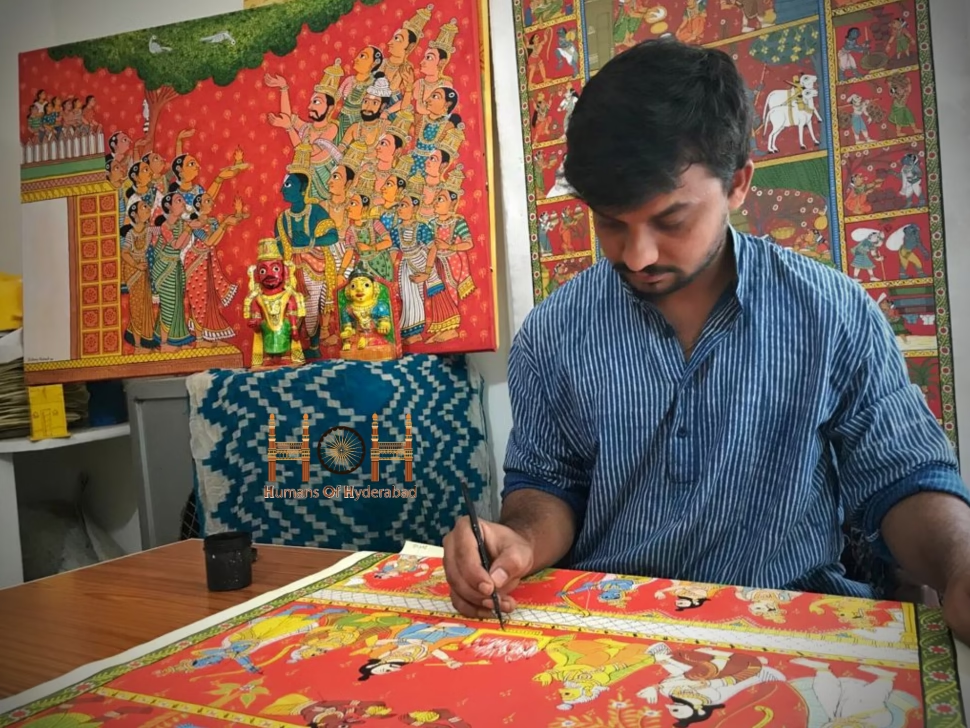
The authenticity of Cheriyal scroll painting depends entirely on natural materials. Synthetic substitutes exist today, but traditional artists refuse them. Below is a complete material list.
Base Fabric (Khadi Cloth)
- Handwoven cotton khadi. Not mill fabric.
- Thickness: Medium (holds paste without cracking).
- Width: Usually 18–24 inches. Length varies by story.
Preparatory Paste (Gachcha)
- Tamarind seed powder – Soaked overnight, ground into glue.
- White clay (silica-rich, from local riverbeds).
- Gum arabic – Acts as a binder.
- Old jaggery – Adds flexibility. Prevents cracking.
Natural Pigments (All locally sourced)
| Color | Source | Preparation |
| Deep red | Crushed laterite stones | Ground for 3 hours and mixed with water |
| Indigo blue | Indigofera plant leaves | Fermented, dried into cakes |
| Black | Lampblack (soot) | Collected from castor oil lamps |
| Yellow | Turmeric + alum | Boiled, strained, cooled |
| White | Crushed seashells | Burnt, powdered, sieved |
| Green (rare) | Indigo and turmeric mixed | Combined fresh on palette |
Brushes
- Squirrel hair brushes – For fine outlines (dots and borders).
- Palm leaf brush – For thick fills (red and yellow areas).
- Bamboo stick – For the final black outline (dipped and guided by hand).
Varnish (Final Protection)
- Neem seed oil + crushed resin – Boiled together, applied hot.
Note: A single 20-foot scroll consumes approximately 200 grams of tamarind seeds, 50 grams of lampblack, and 3 meters of khadi cloth.
Steps of Making Cheriyal Scroll Painting
Creating a Cheriyal scroll painting requires 12 to 18 days for a 20-foot scroll. Below is the step-by-step process.
Step 1: Cloth Preparation (Day 1–2)
- Cut khadi to required length (e.g., 20 feet).
- Wash in river water to remove starch.
- Dry in shade completely.
Step 2: Applying Gachcha Paste (Day 3)
- Mix tamarind seed paste + white clay + gum arabic.
- Apply evenly with a wooden spatula.
- Layer thickness: Paper-thin (1–2 mm).
- Dry for 6 hours. Apply second coat.
- Final surface should feel like soft leather.
Step 3: Drawing the Outline (Day 4)
- No pencil or charcoal. Directly with a thin brush.
- Artist starts from left edge. Moves right.
- Figures drawn first. Then borders. Then the background.
- Proportion rule: Head = 1/8th of total figure height.
Step 4: Applying Base Colors (Day 5–8)
- Order: Yellow → Red → Indigo → White → Black (last).
- Each color was dried for 4 hours before the next.
- Red is used for backgrounds. Indigo for skies.
- White dots for borders and jewelry.
Step 5: Final Black Outline (Day 9)
- Thickest brush (palm leaf base).
- Traces every figure, every fold of clothing.
- This is the signature step. One mistake = restart.
Step 6: Drying & Curing (Day 10–11)
- A scroll hung vertically in the shade.
- No direct sunlight (cracks paint).
- Light breeze for 48 hours.
Step 7: Varnishing (Day 12)
- Heated neem resin applied with cotton cloth.
- Thin layer. Rub gently.
- Dries in 24 hours to matte finish.
Step 8: Rolling & Storage (Day 13)
- Rolled from right to left (opposite of reading direction).
- Wrapped in muslin cloth.
- Stored horizontally. Never folded.
Total time for a 40-foot epic scroll: 25–30 days
Traditional rule: One artist cannot make a scroll alone. A nakash (painter) must work with a golla (singer) who tests the scroll by singing through it scene by scene. If the singer stumbles, the painter revises.
FAQs:
Q1. Is Cheriyal scroll painting the same as Pattachitra?
No. Pattachitra is from Odisha and uses finer lines and mythological themes only. Cheriyal has bolder colors, exaggerated figures, and includes satire and folk tales.
Q2. How long does an original Cheriyal scroll last?
If kept rolled in a dry place away from sunlight, a genuine scroll lasts 80–100 years. The tamarind paste base acts as a natural preservative.
Q3. Can I wash a Cheriyal scroll if it gets dirty?
Absolutely not. Water dissolves the gachcha paste. Use a dry, soft brush or consult a textile conservator.
Q4. Why do the figures have such large hands and popping eyes?
The scrolls were performed at night in open villages. Large hands and bulging eyes helped the last row of villagers see expressions from 50 feet away.
Q5. Are all Cheriyal scrolls religious?
No. Historical types included social satire, erotic folk tales, and even legal genealogical records. Only modern commercial scrolls focus heavily on gods.
Q6. How many artists make authentic Cheriyal scrolls today?
Fewer than 20. Most belong to or were trained under the Nakash family in Cheriyal village. Many others paint in the “Cheriyal style” but skip traditional methods.
Q7. Do artists still use natural pigments?
Some do. But due to cost and time, many now use poster colors. The Nakash family still prepares laterite red and lampblack traditionally.
Q8. What is the cheapest authentic Cheriyal scroll I can buy?
A 2-foot miniature votive scroll starts at ₹2,000–₹3,000. Anything below that is likely a machine print or synthetic imitation.
Q9. Why did the singing tradition (golla) die?
Younger generations no longer learned oral epics. Mobile phones and TV replaced all-night storytelling. Today, scrolls are sold as decor, not performed.
Q10. Can I commission a custom Cheriyal scroll of my family?
Yes. Some artists take custom orders. A 6-foot family scroll with 5–6 figures costs roughly ₹15,000–₹25,000 and takes 15–20 days.
Also Read:
Kalamkari Comeback: How Hand-Painted Textiles Are Winning Over Gen Z

Leave a Reply